Wednesday, February 15, 2017

What to do in the Garden in February


Planning
    Select and store healthy scion wood for grafting fruit and nut trees. Wrap in damp cloth or peat moss and place in plastic bag. Store in cool place.


    Plan an herb bed. Choose a sunny spot and plant seeds or transplants once the danger of frost has passed (late-April or early-May).


    Plan to add herbaceous perennial flowers to your flowering landscape this spring. Ex:  sweet alyssum, yarrow, penstemon, and coneflower.


Maintenance and Clean Up
    Make a cold frame or hotbed to start early vegetables or flowers.


    Cut and lightly incorporate cover crops or other organic matter into soil.


    Prune and train grapes; take cuttings.

  See this link for many helpful publications.
    Prune apple trees.  See this link for many helpful publications.
    Prune fruit trees.  See this link.
    Prune blueberries. Watch a video on blueberry pruning here.
    Prune deciduous summer-blooming shrubs and trees
    Prune and train trailing blackberries and black raspberries.


    Prune fall-bearing raspberries (in late-February or early-March).


Planting/Propagation
    Plant windowsill container gardens of carrots, lettuce, or parsley.


    Good time to plant fruit trees and deciduous shrubs. Replace varieties of ornamental plants that are susceptible to disease with resistant cultivars or natives.
    Plant asparagus if the ground is warm enough.


    Plant seed flats of cole crops (cabbage, cauliflower, broccoli, and Brussels sprouts), indoors or in a greenhouse.


    Where soil is dry enough and workable, plant garden peas and sweet peas.

Pest Monitoring and Management
    Monitor landscape plants for problems. Don't treat unless a problem is identified.


    Use delayed-dormant sprays of lime sulfur for fruit and deciduous trees and shrubs.


    Elm leaf beetles and box-elder bugs are emerging from hibernation and may be seen indoors. They are not harmful, but can be a nuisance. Remove them with a vacuum or broom and dustpan.


Tuesday, January 17, 2017

What to do in the Garden in January

Sustainable gardening
The Oregon State University Extension Service encourages sustainable gardening practices.
Preventive pest management is emphasized over reactive pest control. Identify and monitor problems before acting and opt for the least toxic approach that will remedy the problem. The conservation of biological control agents (predators, parasitoids) should be favored over chemical controls.
Use chemical controls only when necessary and only after thoroughly reading the pesticide label. First consider cultural, then physical, and biological controls. Choose the least-toxic options if you have tried physical and biological controls and must resort to pesticides (insecticidal soaps, horticultural oils, botanical insecticides, and organic and synthetic pesticides — when used judiciously).
  • Gather branches of spring flowering shrubs or trees and bring indoors to force an early bloom.   See this link
  • Here is a list of possible species for forcing:
  • Cercis canadensis-Redbud
    Chaenomeles spp-Japanese or Flowering Quince 
    Cornus florida-Flowering Dogwood 
    Hamamelis vernalis-Vernal Witch Hazel 
    Crataegus spp-Hawthorn 
    Forsythis spp-Forsythia 
    Lonicera spp-Honeysuckle 
    Magnolia soulangiana-Saucer Magnolia 
    Magnolia stellata-Star Magnolia 
    Malus spp-Apple and Crabapple 
    Prunus spp-Flowering Almond, Cherry & Plum 
    Salix caprea-European Pussy Willow 
    Spiraea spp-Spirea 
    Syringa spp-Lilac 
    Viburnum spp-Viburnum

Planning
  • Plan to replace varieties of ornamental plants that are susceptible to disease with resistant cultivars in February.
  • Take hardwood cuttings of deciduous ornamental shrubs and trees for propagation.
  • Have your soil tested in your garden plot to determine its nutrient needs. Here is a guide to collecting soil samples.  The Master Gardener help desk can test the pH for you or check this list of laboratories for a more complete soil test (for a fee). Click this link for a list of laboratories serving Oregon.  
  • Begin planning this year’s vegetable garden. Check with local retail garden or nursery stores for seeds and seed catalogs.
  • Keep a garden journal. Consult your journal in the winter, so you can better plan for the growing season.
Maintenance and Clean Up
  • If necessary, place windbreaks to protect sensitive landscape evergreens against cold, drying winds.
  • Reapply or redistribute mulch that has blown or washed away during winter.
  • Clean pruners and other small garden tools with rubbing alcohol.
  • Water landscape plants underneath wide eaves, covered porches, greenhouses, garages, and in other sites shielded from rain.
  • If possible, avoid walking on lawns until frost has melted.
Pest Monitoring and Management
  • Scout cherry trees for signs and symptoms of bacterial canker. Remove infected branches with a clean pruner or saw. Sterilize tools before each new cut. Burn or send to landfill before bloom. See this link for Managing Diseases and Insects in Home Orchards.
  • Watch for field mice damage on lower trunks of trees and shrubs. Eliminate hiding places by removing weeds and keeping mulch a few inches away from trunks.
  • Use dormant sprays of lime sulfur or copper fungicide on roses for general disease control, or, better yet, plan to replace susceptible varieties that have been doing poorly with resistant cultivars.   List of Rose Cultivars' Resistance to Disease
  • Moss occurs in lawns due to shade or poor drainage. This is not usually a problem – moss doesn’t require mowing and still provides a soft green surface.  If your site is heavy in foot traffic and becomes unsightly, installing mulched paths may be a good option.  If more grass is desired, careful limbing up of trees to the south of the site may be helpful.  If poor drainage is an issue, consider working with nature and planting the area as you would a rain garden.  See the free download of the Oregon Rain Garden Guide for ideas.  After you click the link look at the bottom of the page for the free download.  
  • Mid-January: Spray peach trees with approved fungicides to combat peach leaf curl and shothole.  Better yet, consider planting curl-resistant cultivars such as Frost, Q1-8, or Creswell.
  • Monitor landscape plants for problems. Don't treat unless a problem is identified.
Houseplants and Indoor Gardening
  • Monitor houseplants for correct water and fertilizer; guard against insect infestations; clean dust from leaves with a soft damp cloth or a brief shower.  If you have hard water and the resulting hard water deposits may be unsightly, collect a little rainwater to use as a last rinse for your plant’s shower.
  • Protect sensitive plants such as weeping figs from cold drafts in the house.
  • Propagate split-leaf philodendrons and other leggy indoor plants by making vegetative cuttings or air-layering.  
  • Plant dwarf annual flowers inside for houseplants, including coleus, impatiens, and seedling geraniums.

Tuesday, January 10, 2017

Gearing up for Gardening Starts Today!

Join us at the library for a fun, free talk about one of our favorite subjects every Tuesday at lunch time from now until the end of February.  The speakers are from area nurseries, OSU, and the Dept. of Agriculture.  They all have a great deal of knowledge and tips to share. The main meeting room is to the right as you approach the front entrance of the library.


Monday, January 2, 2017

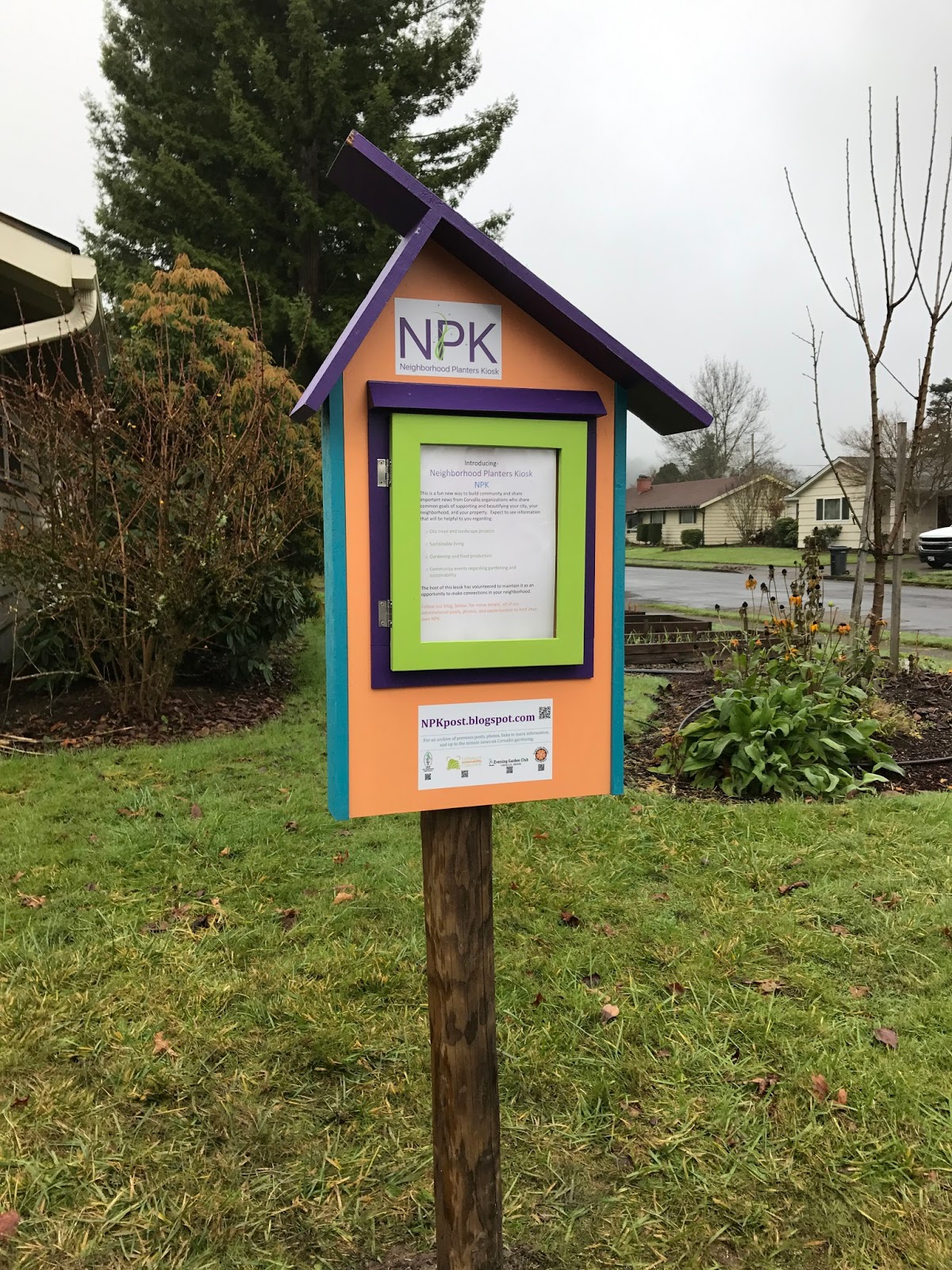
We have 2 more NPKs installed!

Welcome Adriane Marler and Doug Glavich, and Avie Meadows and her family!  We hope you have as much fun with your new NPKs as we do!

Look for this one along Kings a little ways north of Grant.

Our first pairing with a little library!  Hoorah! 


Many thanks to Karl for all of his hard work with installation!

Saturday, December 3, 2016

What to do in the Garden in December


These are reminders of key garden chores, such as fertilizing,  planting, maintenance, and pest control for this month. These are for reference only and no one need feel like they should do everything on the list even if they do all apply to your yard.  Gardening should be fun!  Just do what you can and pick the things that are most important to you first.

Maintenance and Clean Up

   Protect new landscape plants from wind. Use stakes, guy wires (with some flexibility) and/or windbreaks as needed.  Plan to loosen wires in spring to allow for growth and some movement.  The swaying of the trunk encourages it to grow stronger. Trees should not be tied in place longer than one growing season, in most cases. See this article for more.
Stake 1/3 up the tree if necessary.  Allow some flexibility.
Photo from University of Minnesota.

   Rake leaves and use to mulch flowerbeds or make a compost pile if you have space.  See this list of OSU extension articles for more.  If leaves have significant disease problems, as in some rose, tomato, or fruit tree leaves, for example,  it may be best to hot compost or place them in yard debris bins. See this article about hot compost
   If you have a compost pile already, turn the pile and protect from heavy rains to protect nutrients from being washed away.
   You can also start getting a new bed ready for spring planting by simply piling leaves on very thickly (10-20") to kill grass.   This head start plus keeping plenty of mulch around new plantings will improve the soil and give your plants a great spot to grow without competition or herbicides.  
The dark leaves have just been brought in to start a new bed that will save us from mowing
 around the trees and add habitat value. The lighter leaves were raked up from those trees earlier and used to mulch existing beds- preventing weeds, improving soil, protecting tender plants, conserving moisture come summer time, and saving us time doing too much raking and weeding.  Yay leaves!
   Hoe or pull winter weeds.  If you have a patch with many weeds, you may save time by covering them with cardboard and then mulching over the cardboard.  Just hoe any survivors.  There won't be many.
Cardboard weed suppression.  Cover with mulch of your choice.
   Spread wood ashes evenly on the vegetable garden. Use no more than 1.5 lb/100 sq ft/year. Don't use if the soil pH is greater than 7.0 or if potassium levels are excessive.  
   During heavy rains, watch for drainage problems in the yard. Ditching and French drains are possible short-term solutions. Consider rain gardens and bioswales as a longer-term solution and a fun excuse to do some landscaping.  See this download of a booklet from the City of Portland with photographs and rain garden design, construction, and planting information.  Don't forget to click on the download. 
Three year old rain garden.  It has river rock (3" drainage rock) mulching the bottom of the ponding area, but the native strawberry has spread with such exuberance that it is hard to see.  This ponding area absorbs all of the rain from the small barn so quickly that standing water is never visible, even during a downpour.  Plants in and around the rain garden include native shrubs and rushes, flowering perennials, grasses, and fruit trees.
   Check stored flower bulbs, fresh vegetables, and fruits for rot and fungus problems. Discard any showing signs of rot.
   Tie limbs of columnar evergreens to prevent snow or ice breakage.
   If possible, avoid walking on frosty lawns until frost has melted.
   If you have landscape plants in protected sites that don’t receive rain, remember to water them occasionally during the winter. 

Planting/Propagation
   Good time of year to plant trees and landscape shrubs.  See this article for how to's and information about a helpful new app for tablets. 

Dig the hole twice as wide, but no deeper than the pot.
A garbage bag  under the loose soil makes clean up easy.
   Check that your seeds are sealed up tightly somewhere cool or cold.  A small packet of silica gel or dry milk can help absorb any residual moisture.

Pest Monitoring and Management
   Monitor landscape plants for problems. Don't treat unless a problem is identified.
   Check for rodent damage around bases of trees and large shrubs. Remove weeds to prevent rodents from using them as hiding places.
   Avoid mounding mulching materials around the bases of trees and shrubs. The mulch might provide cover for rodents.
   Monitor spruce trees for spruce aphids. Treat only if present in large numbers. Read and follow pesticide label directions. 
   Identify problems before acting, and opt for the least toxic approach. Cultural, physical and biological controls are the cornerstones of a sustainable pest management program. Use chemical controls only after you identify a pest problem and carefully read the pesticide label. Least-toxic choices are insecticidal soaps, horticultural oils, botanical insecticides and organic and synthetic pesticides. These recommendations might not apply to all areas of Oregon. For more information, contact MasterGardeners by phone or email on this website. 

Houseplants and Indoor Gardening
   Protect poinsettias from cold, place in sunlight, don't let leaves touch cold windows; fertilize with houseplant fertilizer to maintain leaf color.

Monitor houseplants for adequate water and fertilizer. Water and fertilizer requirements generally are less in winter.

Please comment and ask questions!  We'd love to hear from you!